

Views: 0 Author: Site Editor Publish Time: 2026-09-20 Origin: Site


Did you know that modern robotic surgeries require articulation tools with internal mechanisms smaller than a coin? The global medical device industry is undergoing a massive transformation. Driven by the rapid expansion of minimally invasive surgeries (MIS) and robotic-assisted procedures, the engineering requirements for surgical hardware have become incredibly demanding. Recent industry analyses highlight a significant trend: the robotic surgery market is expanding at a double-digit annual growth rate, forcing healthcare providers to seek out highly precise, yet economically viable, mass-produced instruments.
Traditional subtractive machining often struggles to produce these microscopic, highly intricate parts at a price point that makes mass production feasible. Cutting away solid metal blocks to form tiny gears and thin-walled tubes is not only time-consuming but also generates a staggering amount of material waste. To overcome this critical bottleneck, medical device engineers are increasingly turning to an advanced fabrication technology that perfectly bridges the gap between the geometric freedom of plastic molding and the robust mechanical performance of forged metals.
At its core, Medical Metal Injection Molding is a sophisticated metallurgical process engineered to produce small, highly detailed metal parts at scale. By utilizing ultra-fine metal powders mixed with specialized binders, manufacturers can mold complex geometries that would be physically impossible—or financially ruinous—to create with standard CNC cutting tools. Once processed, these parts achieve material densities and tensile strengths that rival traditional metalworking techniques, operating with virtually zero geometric constraints.
To fully grasp how raw metallic dust is transformed into clinical-grade hardware, it is essential to examine the highly controlled manufacturing sequence. The production follows a strict metallurgical pathway to ensure absolute structural integrity:
Compounding: Fine metal powders, typically under 20 microns in diameter, are aggressively blended with a primary thermoplastic binder and a secondary wax binder. This creates a uniform, moldable "feedstock" designed to flow seamlessly into intricate mold cavities.
Injection Molding: The customized feedstock is heated and injected into a precision-machined steel mold under extreme pressure to form the "green part." While this part holds the exact geometric details of the final design, it is deliberately molded 15% to 20% larger to account for later shrinkage.
Debinding: The green part is subjected to a chemical, catalytic, or thermal bath to extract the primary polymer binders. The result is the "brown part," where the remaining secondary binder acts as a temporary glue holding the delicate metal particles together.
Sintering: In the final and most critical stage, the brown part is heated in a controlled-atmosphere furnace to near-melting temperatures, often exceeding 1300°C. The remaining binder burns off, and the metal particles fuse together. This eliminates internal voids, achieving up to 99% theoretical material density.
The shift towards value-based, precision care introduces significant engineering hurdles. Devices must now operate within highly confined anatomical spaces, requiring micro-features such as tiny articulation gears, internal undercuts, and microscopic gripping teeth. Imagine a surgeon navigating a laparoscopic grasper through a 5mm trocar; the internal mechanisms driving that movement are smaller than a match head.
Producing these microscopic features using standard subtractive manufacturing is exceptionally difficult. Traditional cutting tools possess rigid physical limitations. They cannot easily reach inside deep blind cavities or machine sharp internal corners without specialized, time-consuming multi-axis setups. Furthermore, when creating intricate medical instrument parts out of solid billets via CNC machining, the material waste can be astonishing. In some complex surgical tools, up to 80% of the expensive, medical-grade raw material is literally machined away as scrap swarf.
In high-volume production scenarios, this combination of heavy material waste, multiple tool changes, and slow output drastically drives up the unit cost. Consequently, traditional machining becomes financially unviable for mass-market medical devices.
For procurement managers and lead engineers evaluating fabrication methods, this technology offers a distinct set of value propositions that directly neutralize the limitations of subtractive machining.
The foremost engineering advantage is unmatched geometric complexity. Because the feedstock flows into a mold exactly like molten plastic, designers can effortlessly incorporate internal threads, asymmetrical profiles, cross-holes, and aggressive surface textures in a single operation. There is no need to worry about tool access angles or spindle clearance. If a convoluted shape can be molded in plastic, it can generally be molded in solid metal.
Historically, a sophisticated medical device consisted of multiple simple parts machined separately and then assembled via laser welding, brazing, or micro-fasteners. This multi-part assembly inherently introduces points of failure, drives up manual labor costs, and complicates supply chain logistics. MIM empowers engineers to redesign these fragmented assemblies into a single, cohesive component. Consolidating parts eliminates assembly risks, a factor that is absolutely critical in surgical settings where structural failure is not an option.
To provide a clearer engineering perspective, consider the following comparison between MIM and traditional CNC machining:
| Feature / Metric | Metal Injection Molding (MIM) | Traditional CNC Machining |
|---|---|---|
| Optimal Production Volume | High (10,000+ units/year) | Low to Medium (1 - 5,000 units/year) |
| Material Waste | Minimal (Near-net shape, <5% waste) | High (Up to 80% swarf on complex parts) |
| Geometric Complexity | Unlimited (Internal cavities, undercuts are free) | Limited by tool access and setup changes |
| Per-Unit Cost at Scale | Low (Rapid cycle times) | High (Serial line-by-line cutting) |
Material science forms the foundation of medical device compliance. Components must adhere to strict FDA and MDR regulatory standards regarding biocompatibility, toxicity, and mechanical reliability. Due to its exceptional metallurgical properties, stainless steel MIM has emerged as the undisputed industry standard, offering specific mechanical parameters that engineers can rely on.
316L Stainless Steel: This austenitic stainless steel is renowned for its superior corrosion resistance and non-magnetic properties. The "L" designates a low carbon content, which minimizes carbide precipitation during the high-heat sintering process, thereby enhancing its resistance to intergranular corrosion. Typical MIM 316L achieves a sintered density of ≥7.9 g/cm³, an ultimate tensile strength (UTS) of around 520 MPa, and excellent biocompatibility. It is frequently utilized for surgical implants, orthopedic fixation devices, and instruments in prolonged contact with bodily tissues.
17-4 PH Stainless Steel: When a specific clinical application demands high yield strength, hardness, and extreme wear resistance, 17-4 PH (Precipitation Hardening) is the preferred alloy. As a martensitic stainless steel, it can be heat-treated post-sintering. Engineers can expect a sintered density of ≥7.6 g/cm³ and a hardness reaching 35-40 HRC after H900 heat treatment. This makes 17-4 PH ideal for load-bearing tools, bone saws, robust forceps, and structural components within robotic arms that must endure significant mechanical stress.
In addition to mechanical strength, surgical instruments are subjected to hospital sterilization protocols—some of the harshest environments conceivable. Because sintered parts achieve near-full density (typically 96% to 99%), there is virtually no interconnected internal porosity. This dense structure prevents the ingress of corrosive sterilization chemicals, ensuring the components do not degrade or harbor dangerous bacteria over their operational lifecycle.
To truly appreciate the practical impact of this technology, it is helpful to examine specific clinical devices where molding has successfully replaced traditional subtractive methods.
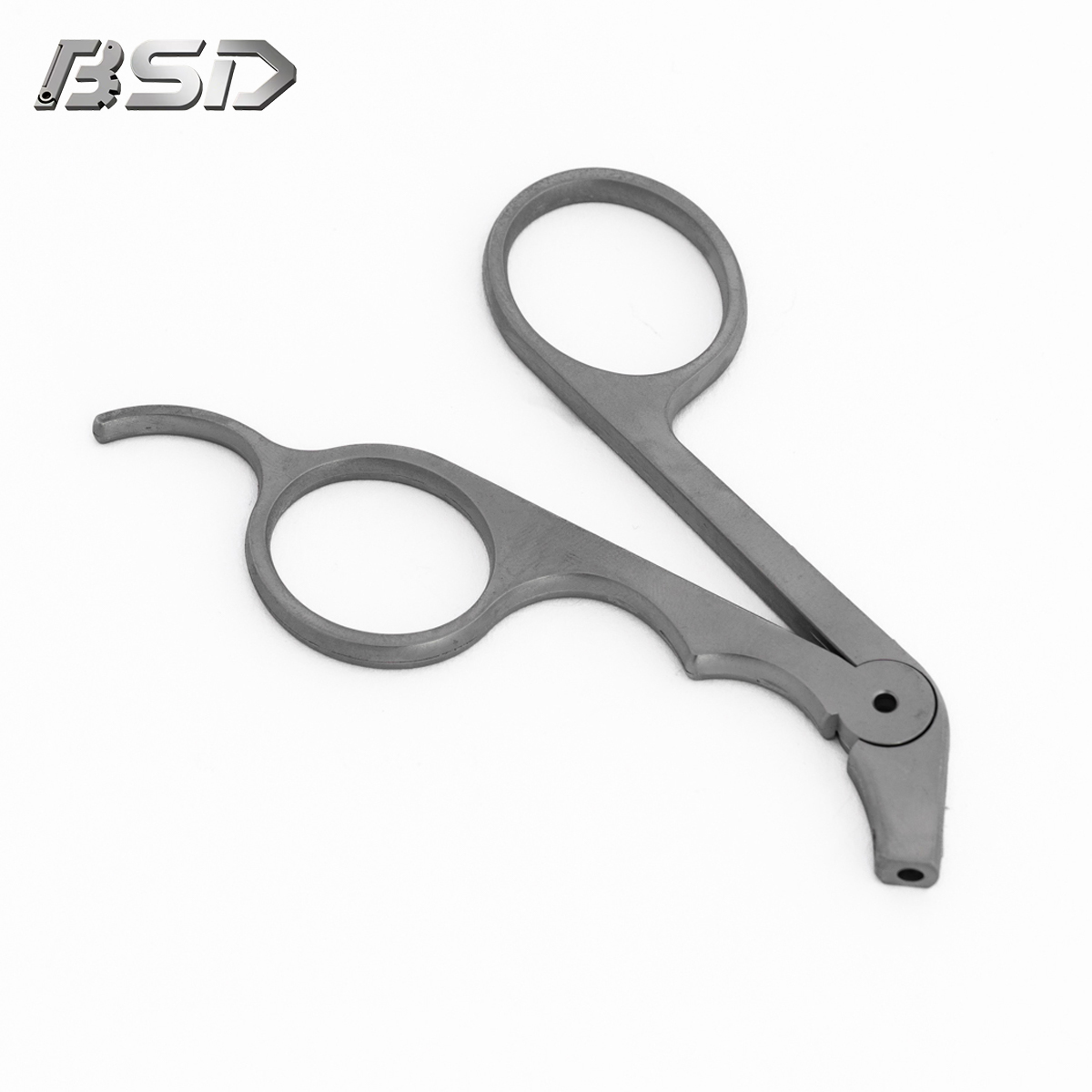
A medical scissor handle represents a perfect candidate for this process. These handles require complex, ergonomic, three-dimensional curves to ensure surgeon comfort and precise tactile feedback during marathon operations. Simultaneously, the cutting jaws demand high mechanical strength and complex mating surfaces to ensure a clean, shearing cut through tissue. Machining these organic ergonomic curves is incredibly slow and expensive. Molding allows these sweeping shapes and robust mechanical features to be formed simultaneously, producing highly reliable surgical tools at a fraction of the traditional cost.
Furthermore, the entire field of minimally invasive surgery relies heavily on endoscopic and laparoscopic tools. These devices feature long, narrow shafts equipped with microscopic mechanisms at the distal end. The industry routinely deploys this technology to mass-produce the intricate articulation gears, graspers, dissecting spatulas, and trocars found in these systems. The ability to manufacture these micro-sized components with absolute repeatability ensures that both single-use and reusable laparoscopic tools remain economically feasible.
To maximize the economic and structural benefits of this process, medical device engineers must apply specific Design for Manufacturability (DFM) principles. Designing for a molded metal part is vastly different from designing for a CNC milled part; it requires a deep understanding of fluid dynamics during the injection phase and thermal dynamics during sintering.
Maintaining a uniform wall thickness is arguably the most critical design rule. Thick cross-sections take significantly longer to cool and debind, making them highly susceptible to "sink marks" or internal voids. Engineers should aim for nominal wall thicknesses between 1mm and 3mm. If a bulky section is structurally necessary, it should be hollowed out using a technique called "coring." Transitioning smoothly between different wall thicknesses using generous radii and fillets prevents stress concentrations and structural warping.
During the final furnace stage, the removal of binders and the fusing of metal particles cause the component to shrink uniformly by approximately 15% to 20%. Expert tooling engineers calculate this shrinkage factor with mathematical precision during the mold design phase. By strictly controlling the feedstock composition and furnace temperature profiles, manufacturers can achieve tight tolerances for precision MIM components, typically ranging from ±0.3% to ±0.5% of the nominal dimension.
Clinical devices also require exceptionally smooth surface finishes to prevent bacterial harboring. One of the distinct advantages of this process is the high quality of the "as-sintered" surface finish, which generally ranges from Ra 1.6 to 3.2 μm (63 to 125 micro-inches). If a mirror-like finish is required, the sintered parts respond excellently to secondary centrifugal tumbling or electropolishing.
When evaluating manufacturing processes for a new medical device rollout, engineering teams frequently face a critical crossroads: stick with traditional CNC machining or transition to forming technologies. Making an evidence-based decision requires a practical analysis of part volume, material utilization, and dimensional complexity.
CNC machining remains an indispensable technology, particularly for low-volume production runs (under 5,000 units annually) or during the iterative phases of clinical trials. It requires zero upfront tooling investment, allowing engineers to modify CAD designs rapidly. If a component is massive, features a simplistic geometry, or requires ultra-tight tolerances (down to ±0.005 mm) across the entire body, machining is often the superior choice.
Conversely, transitioning to injection molding becomes the statistically and economically sound decision when high-volume scalability is required. Once annual production volumes exceed 10,000 units, the initial investment in mold tooling is rapidly amortized. Because molding produces parts in parallel via multi-cavity molds, rather than the serial line-by-line cutting of CNC, the per-unit cost drops precipitously. In this realm, "complexity is free." By eliminating material waste and drastically reducing cycle times, manufacturers typically observe a 30% to 50% reduction in per-part costs.
The regulatory landscape for medical devices demands absolute material traceability, stringent risk management, and uncompromised structural integrity. Consequently, selecting a vendor to produce MIM medical components is not merely a supply chain decision; it is a critical compliance mandate.
The absolute baseline requirement for any medical manufacturing partner is active ISO 13485 certification. The vendor must demonstrate rigorous Installation Qualification, Operational Qualification, and Performance Qualification (IQ/OQ/PQ) for their injection presses and sintering furnaces. This ensures every single batch maintains consistent density and mechanical properties.
Beyond standard certifications, the most successful medical device programs utilize manufacturing partners who offer comprehensive, vertically integrated solutions. Fragmenting the supply chain—having one company design the mold, another shoot the parts, and a third handle the passivation—introduces unacceptable levels of risk and dimensional variation. A top-tier partner will maintain robust in-house capabilities, including mold fabrication, secondary CNC sizing, and medical-grade surface finishing. Consolidating these processes under one roof accelerates time-to-market and guarantees clinical safety.
As the healthcare landscape continues to evolve, surgical devices are becoming smaller, more intricate, and vastly more sophisticated. Traditional subtractive machining simply struggles to keep pace with the demand for miniaturized complexity at mass-production scales. This advanced metallurgical process offers the perfect triad of geometric freedom, mechanical strength, and economic scalability. By drastically lowering per-unit costs for high-volume production runs while eliminating material waste, it empowers engineers to push the boundaries of what is possible in the operating room.
If your engineering team is struggling with the high costs of machining complex parts, or facing unacceptable material waste, it is time to re-evaluate your manufacturing strategy. We encourage you to submit your CAD files for a comprehensive design review. Visit BSD Machinery to explore our vertically integrated manufacturing capabilities and discover how we can help bring your next-generation medical devices to market efficiently and reliably.
Yes. When utilizing industry-standard and highly controlled materials, these components easily meet strict biocompatibility requirements. Materials such as 316L stainless steel, 17-4 PH stainless steel, and Titanium alloys are commonly processed. When manufactured under strict quality controls to achieve near-theoretical density, these parts comply with ISO 10993 standards, making them entirely safe for temporary surgical contact and, in certain material cases, long-term implantation.
The standard tolerance range for "as-sintered" components is typically ±0.3% to ±0.5% of the nominal dimension. Because the parts shrink uniformly during the sintering process, expert mold designers mathematically account for this dimensional change. If a medical device requires tighter tolerances on specific features—such as a press-fit shaft or a fluid-sealing surface—secondary operations like CNC coining, grinding, or honing can be applied to achieve tolerances as tight as ±0.01 mm.
During the final sintering phase, as the binders are removed and the metal particles fuse together to reach full density, the part will typically shrink between 15% and 20%. This shrinkage is highly predictable and uniform. Tooling engineers meticulously calculate this exact shrinkage factor based on the specific feedstock formulation, ensuring the final sintered part perfectly matches the intended CAD dimensions.
Absolutely. Parts manufactured from high-grade alloys exhibit extreme density (often 96% to 99% of theoretical density) and lack interconnected internal porosity. This solid physical structure, combined with the inherent corrosion resistance of the chosen alloys, ensures they are highly durable. They can easily withstand the harsh conditions of repeated hospital sterilization protocols, including high-temperature steam autoclaving, gamma irradiation, and aggressive chemical washes, without degrading or rusting.
Yes. Because the final component is essentially solid metal with near-theoretical density, it behaves exactly like traditionally machined or forged metal. These parts can be seamlessly laser welded, brazed, or subjected to various surface treatments, including electropolishing, passivation (such as citric acid passivation per ASTM A967), and specialized medical-grade plating like gold or titanium nitride (TiN) coating.
Because the process requires an initial capital investment in precision steel molds (tooling), it is generally not suited for low-volume prototyping or short runs. Typically, the process becomes highly cost-effective and provides a strong Return on Investment (ROI) at volumes of 10,000 parts or more per year. However, if a component features extreme geometric complexity that would make multi-axis CNC machining prohibitively expensive, molding can sometimes be economically justified at lower volumes, such as 5,000 units annually.


