

Views: 0 Author: Site Editor Publish Time: 2026-07-06 Origin: Site


Engineers and procurement teams face high-stakes decisions when selecting the right process for complex metal components. Balancing density, tensile strength, surface finish, design tolerance, production capacity, material limits, supply ability, and cost is critical. A wrong manufacturing choice can increase unit cost, delay delivery, or limit part geometry.
In many projects, MIM and CNC Machining are compared as competing solutions. In reality, they serve different production strategies. CNC Machining provides 100% density, high strength, and reliable surface quality. However, when parts become smaller, thinner, or more complex, CNC machining can face higher cost and lower supply efficiency.
Metal Injection Molding, also known as MIM, offers around 98% density, high tensile strength, excellent surface finish, strong miniaturization ability, high thin-wall capability, and stronger mass-production supply ability. For complex small metal components, MIM often provides a more balanced long-term solution.
Volume is the Ultimate Filter: CNC Machining is suitable for low-to-medium volume production, while Metal Injection Molding becomes more attractive when production capacity and supply ability are critical.
Tolerance Trade-offs: CNC Machining offers 100% density and high precision, but MIM provides high design tolerance with better miniaturization and thin-wall capability.
The Complexity Factor: Both processes can handle complex parts, but MIM supports complex geometry, thin walls, and small features more efficiently.
Prototyping to Production Pipeline: CNC Machining is useful for early prototypes, while MIM is more suitable for stable, high-volume production after the design is validated.
Subtractive manufacturing processes rely on removing material from a solid metal billet. CNC Machining uses cutting tools, tool paths, rigid fixturing, and machine programming to shape the final part. This process can achieve 100% density, high tensile strength, and high surface finish.
However, CNC Machining has limitations when the component requires very small features, thin walls, or large-scale supply. Its miniaturization ability is generally medium, and its thin-wall ability is relatively low because thin structures may deform, vibrate, or break during cutting. CNC also tends to have high cost, especially when complex geometry increases machining time.
Conversely, net-shape manufacturing builds the component from metal powder and binder. In MIM, fine metal powder is mixed with polymer binder, injected into a mold, debound, and then sintered at high temperature. The final part typically reaches around 98% density while maintaining high tensile strength and high surface finish.
Compared with CNC Machining, MIM performs especially well in miniaturized, thin-wall, and complex components. Its miniaturization ability is high, thin-wall ability is high, production capacity is high, and supply ability is high. This makes MIM particularly suitable for precision metal parts used in electronics, medical devices, automotive systems, industrial components, and compact mechanical assemblies.
MIM parts shrink during the sintering stage, so mold design and process control are essential. Engineers must calculate shrinkage accurately to achieve the final dimension. Although this adds complexity during tooling development, once the mold and sintering parameters are stable, MIM can repeatedly produce complex parts with consistent quality.
This is why MIM is not simply a replacement for CNC Machining. It requires stronger front-end engineering, but it provides better scalability, lower long-term unit cost, and stronger supply capability for complex small metal components.
Balancing dimensional precision and geometry defines the manufacturing limit of any metal component. CNC Machining offers excellent dimensional control and 100% density because it starts from wrought billet material. It is highly suitable when a part requires full-density material and direct-machined accuracy.
MIM provides high design tolerance and strong repeatability in mass production. Although its density is typically around 98%, the process still delivers high tensile strength and high-quality surface finish. For most complex structural components, MIM provides sufficient mechanical performance while improving production efficiency.
Both MIM and CNC Machining can produce complex components. However, the cost structure is different. In CNC Machining, complex features often require more machining time, more tool paths, additional setups, and sometimes 5-axis equipment. This increases cost and reduces supply efficiency.
MIM handles complex geometry more efficiently once the mold is completed. Thin walls, miniature features, internal structures, and intricate shapes can be produced repeatedly with high consistency. Based on the comparison data, MIM offers high complexity, high miniaturization ability, and high thin-wall ability, while CNC Machining provides high complexity but only medium miniaturization ability and low thin-wall ability.
Material density is one of the clearest differences between the two processes. CNC Machining provides 100% density because it uses solid billet materials. MIM typically provides around 98% density after sintering. Although slightly lower than CNC, MIM still provides high tensile strength and strong functional performance.
Both processes support a broad range of engineering metals. However, when materials are difficult to machine, CNC tool wear and machining cost can increase. MIM can be more efficient for hard-to-machine materials because it forms the part through molding and sintering instead of removing large amounts of material.
| Comparison Item | MIM | CNC Machining |
|---|---|---|
| Density | 98% | 100% |
| Tensile Strength | High | High |
| Surface Finish | High | High |
| Miniaturization Ability | High | Medium |
| Thin-wall Ability | High | Low |
| Complexity | High | High |
| Design Tolerance | High | Medium |
| Production Capacity | High | Medium-High |
| Material Limits | High | High |
| Supply Ability | High | Low |
| Cost | Medium | High |
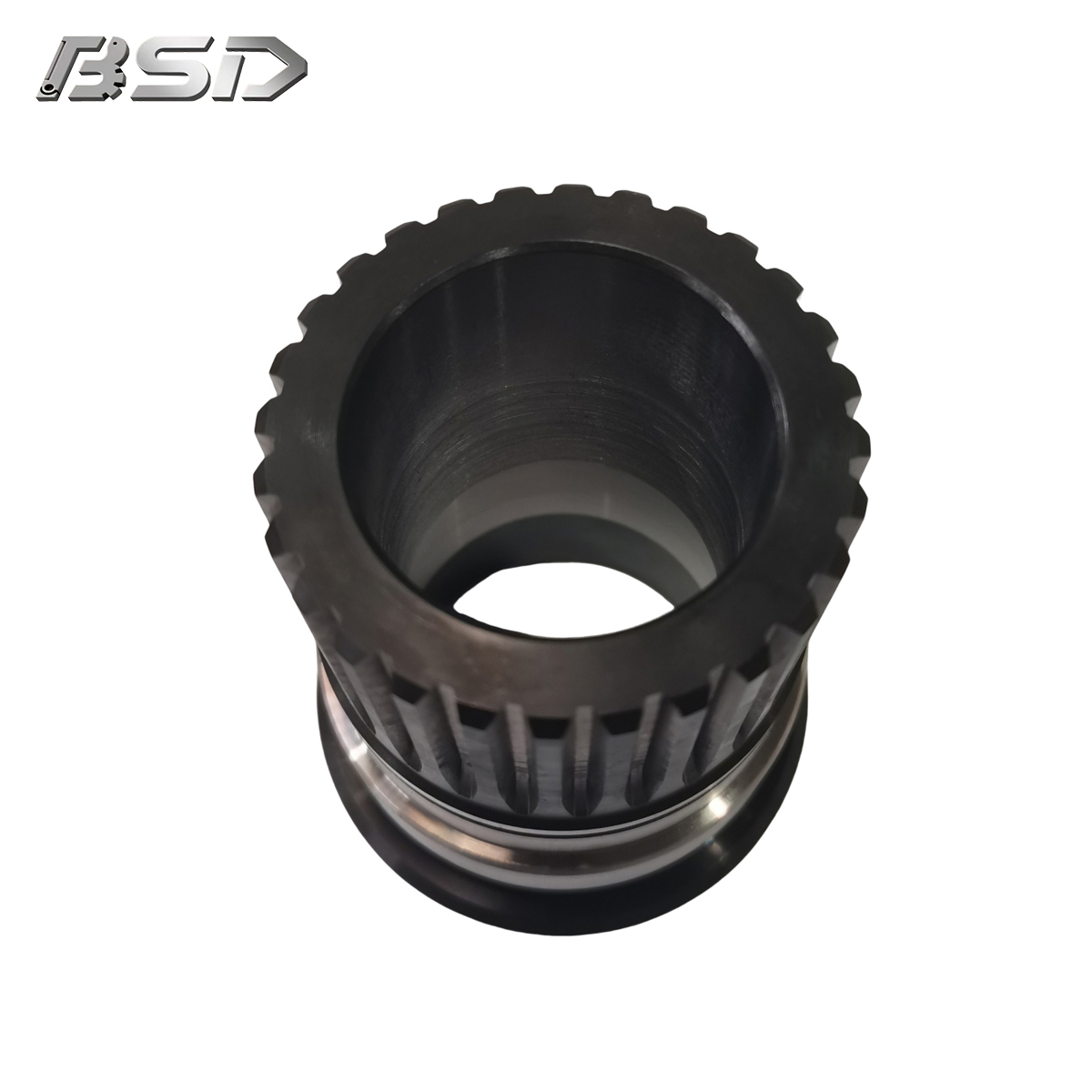
Metal manufacturing process comparison and industrial parts layout
Capital expenditure affects the early manufacturing decision. CNC Machining usually requires lower upfront tooling investment because it depends mainly on programming, fixtures, tools, and machine time. This makes CNC suitable for prototypes, engineering samples, small batches, and early product validation.
MIM requires mold investment before production. The mold cost is higher at the beginning, but it enables stable repeat production after the design is finalized. For projects with confirmed demand, complex geometry, and high production capacity requirements, this upfront investment can be justified by lower long-term unit cost.
CNC Machining costs remain relatively high because every part requires cutting time, operator input, machine capacity, and material removal. Even when order volume increases, the machining time for each part remains a major cost factor.
MIM has a different cost structure. Once the mold is completed and the process is stable, parts can be produced efficiently in high volume. Since MIM has high production capacity and high supply ability, its unit cost becomes more competitive for complex components. According to the comparison data, MIM cost is medium, while CNC Machining cost is high.
The break-even point depends on part complexity, annual volume, material, tolerance requirements, and tooling investment. For simple low-volume parts, CNC Machining may remain the better option. For complex, miniaturized, thin-wall, and high-volume parts, MIM becomes more cost-effective.
| Production Volume | CNC Machining Cost Dynamic | MIM Cost Dynamic |
|---|---|---|
| 1 - 5,000 Units | Economical for prototypes and small batches | Tooling cost is difficult to amortize |
| 5,000 - 15,000 Units | Cost remains tied to machining time | Approaching break-even depending on complexity |
| 15,000 - 50,000+ Units | Costly due to machine time and supply limits | More profitable due to high production capacity |
Lead time is important when launching a new product. CNC Machining offers fast turnaround and is suitable for early prototypes or urgent low-volume production. Engineers can adjust CAD files, update tool paths, and produce revised parts quickly.
MIM requires mold design, mold fabrication, trial production, debinding, sintering, and validation. This means the initial lead time is longer. However, once the process is stable, MIM provides stronger supply ability and higher production capacity, making it more reliable for repeated mass production.
Late design changes create different risks for each process. CNC Machining is flexible because design changes can usually be handled through updated programming or fixture adjustments. This makes CNC suitable when the product design is still changing.
MIM requires the design to be more stable before tooling. Once the mold is cut, changes can be expensive and time-consuming. Therefore, MIM should be selected when the design is validated and production demand is clear.
We strongly recommend adopting a hybrid manufacturing strategy when developing complex metal components:
Prototype and validate the physical geometry using CNC Machining.
Test the market or assembly performance with early machined parts.
Freeze the final engineering design after mechanical performance is confirmed.
Start MIM mold development once demand and geometry are stable.
Transition to MIM for high-volume production to improve production capacity, supply ability, and cost efficiency.
Use these specific parameters to identify the better manufacturing route.
Choose CNC Machining when:
You need 100% density from wrought billet material.
The production volume is low or still uncertain.
The engineering design is still changing.
The component requires immediate prototypes or fast delivery.
Thin-wall or miniature features are not the primary design challenge.
Upfront mold investment is not acceptable.
Choose Metal Injection Molding when:
The component requires high miniaturization ability.
The component requires high thin-wall ability.
The part has complex geometry and stable design.
The project requires high production capacity.
The supply chain needs strong repeatability and high supply ability.
The target is medium-to-high volume production with better long-term cost control.
Neither process is universally better. CNC Machining is ideal for prototypes, low-volume production, full-density parts, and projects that require fast design iteration. It provides 100% density, high tensile strength, and high surface finish, but its cost is higher and its supply ability is lower for complex, high-volume parts.
MIM is better suited for complex, small, thin-wall, and high-volume metal components. It offers around 98% density, high tensile strength, high surface finish, high miniaturization ability, high thin-wall ability, high design tolerance, high production capacity, high material flexibility, strong supply ability, and medium cost.
For complex metal components that require stable mass production, Metal Injection Molding is often the better long-term manufacturing solution. For early-stage development or low-volume production, CNC Machining remains the practical starting point.
A: Yes, they exhibit nearly identical mechanical properties. Sintered parts reliably reach up to 99 percent of theoretical material density. They provide excellent tensile and yield strengths comparable to standard wrought billet materials. You can confidently use them in highly demanding, load-bearing mechanical applications.
A: Prototyping with a true production mold is usually cost-prohibitive. The massive tooling investment makes single-unit runs unviable. We highly recommend using metal binder jetting. Alternatively, use standard subtractive milling to validate the physical geometry. Commit to a steel tool only after finalizing the design.
A: Yes, many molded components still require secondary operations. The thermal sintering process cannot guarantee ultra-tight localized tolerances perfectly. You will often need secondary tapping, reaming, or precise surface grinding. These finishing steps ensure critical bores and mating surfaces meet strict dimensional accuracy requirements.


